
What Homeowners Must Know About Asphalt Driveway Removal
Quick Summary
Interconnected cracking, returning potholes, standing water, and crumbling edges point to base failure rather than surface wear, which puts a drive past the point where patching pays. Overlay works only where the layers below stay sound, and it also raises finished grade in ways that can push water back toward the house. Missouri law requires an 811 call before any digging, and Kansas City permits the drive approach in the public right-of-way while leaving the driveway itself exempt. Old material becomes reclaimed asphalt pavement, with 101.4 million tons returned to use in 2024 at a reuse rate approaching one hundred percent. Rebuilding the base and correcting grade determine how long the new surface lasts.
A driveway is the one piece of hardscape on a residential property that carries vehicle weight every single day, and that duty eventually catches up with it. Most asphalt drives are built to serve somewhere between fifteen and twenty years, though the surface rarely announces the end of that span with a single dramatic failure. What usually happens instead is a slow accumulation of cracks, soft spots, and repairs that stop holding. Asphalt driveway removal enters the conversation at the point where patching stops being an investment and starts being a habit. Here is how to tell when you have reached it.
Signs Your Driveway Has Passed the Point of Repair
Cracking tells you a great deal once you learn to read the pattern. A few isolated linear cracks are ordinary aging and respond well to crack filling. Interconnected cracking spread across wide areas is a different condition, and it indicates that the material supporting the surface has lost strength. Potholes that return in the same spot after patching carry the same message, since the patch sat over a base that never recovered. When several areas of your drive show this pattern at the same time, the surface is reporting a structural problem rather than a cosmetic one.
Settlement and standing water are the other reliable indicators. A drive that holds puddles long after rain has settled unevenly or lost its original slope, and both conditions accelerate everything else. Edges that crumble away from the main body suggest the section was never thick enough or the base has washed out. Age serves as supporting evidence rather than a verdict, since a well-maintained drive can outlast its expected span.
When Removal Makes More Sense Than an Overlay
Resurfacing has a clear condition attached to it. New asphalt placed over an old surface performs well only when the layers underneath are still sound and still holding their shape. Where the base has failed, a fresh layer inherits every weakness below it, and the old cracks work their way upward through the new material within a season or two. You end up paying for a surface that ages on the schedule of the one you were trying to replace.
Height is the second consideration, and homeowners often overlook it. Adding two inches of asphalt raises the finished grade, which can reduce clearance at a garage threshold or push water toward the house instead of away from it. Where the existing slope already sends runoff the wrong direction, resurfacing locks that error in place. Removal gives you the chance to correct grade, rebuild the base, and start the clock over.
What Happens on Removal Day
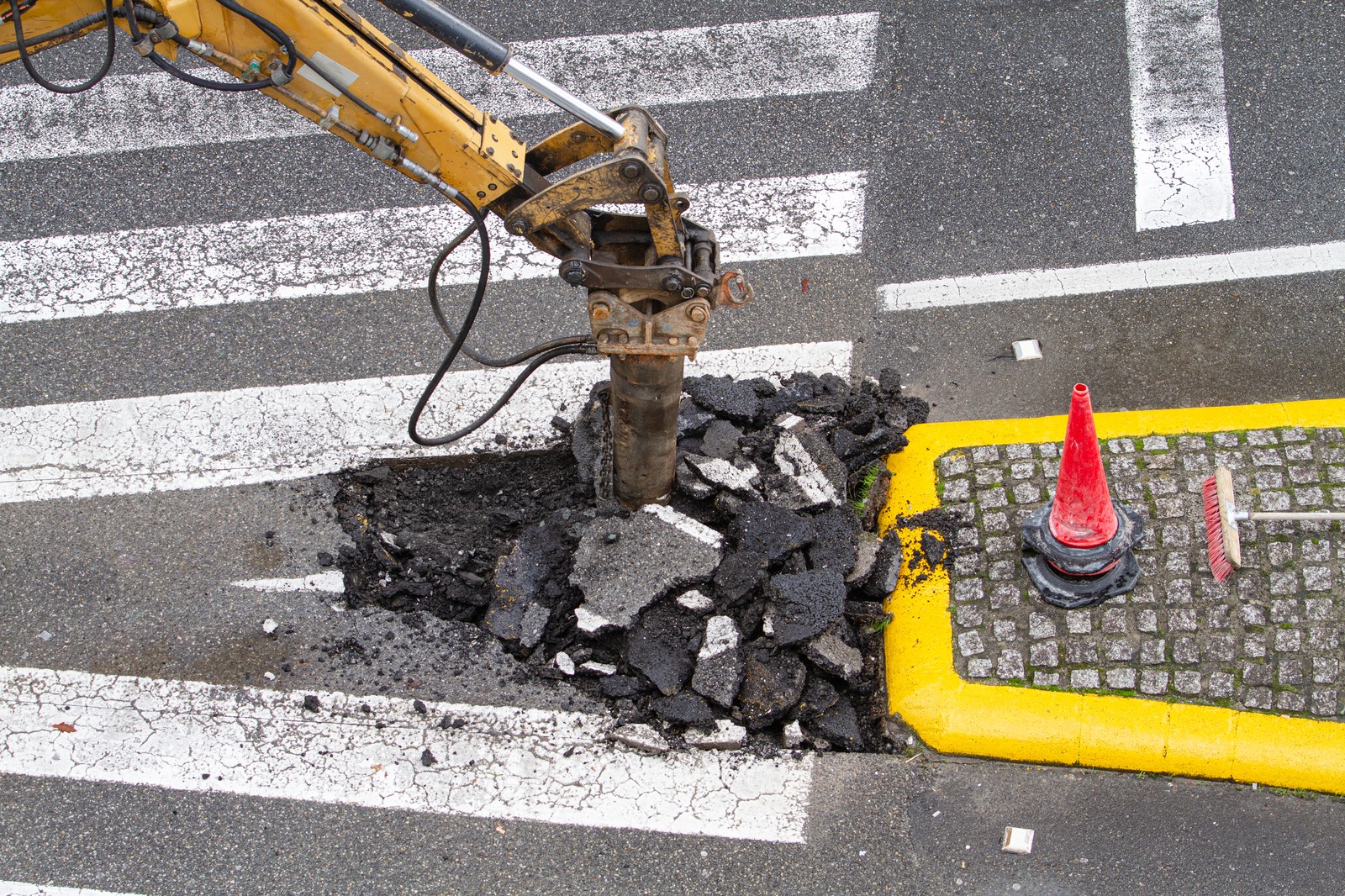
Preparation begins before any machine arrives. Utility locations are marked, landscaping and irrigation heads near the work zone are protected, and vehicles are moved somewhere they will stay accessible. Clean saw cuts are made along the edges where the old surface meets a garage apron, sidewalk, or curb, which keeps the finished joint tight later. A skid steer with a breaker attachment then works across the drive, lifting the material in sections and loading it straight into trucks.
Most residential drives come out in a single working day. Once the surface is clear, the crew gets its first honest look at the base, and that inspection often changes the scope. Soft, wet, or contaminated material has to come out too, which adds depth to the excavation. Weather governs the schedule more than anything else, since saturated ground makes both removal and rebuilding harder to do well.
Permits and Utility Marking Around Kansas City
Notification is a legal requirement rather than a courtesy. Missouri law requires you to contact Missouri 811 before any excavation, including digging on your own property, and Kansas residents use Kansas One Call at the same three-digit number. The service is free, utility owners mark the approximate location of their underground lines, and the process takes a few business days.
Permit rules in the metro are more specific than most homeowners expect. The City of Kansas City, Missouri draws a line at the property boundary, and the driveway and parking pad themselves do not require a permit, while the drive approach in the public right-of-way does require both a permit and an inspection through Development Services. New drives or pads need zoning approval before that application will be accepted, and property owners must carry general liability insurance naming the City. Cities on the Kansas side generally require right-of-way permits for driveway replacement as well, so confirm with your municipality first.
Where Your Old Driveway Ends Up
Very little of what leaves your property becomes waste. Material removed from a drive is hauled to a processing facility, where it is crushed and screened into reclaimed asphalt pavement, then blended back into new mixes.
That performance makes asphalt the most recycled product in the country by tonnage. The binder and aggregate in your old drive hold value, and they can be reprocessed repeatedly without losing their usefulness.
What Comes After the Old Surface Is Gone
Rebuilding starts with the layer nobody sees. The exposed base is evaluated, weak material is removed, and additional aggregate is brought in and compacted until it holds a consistent density across the whole area. Grade is reestablished at this stage, with the surface pitched to carry water away from your garage and foundation. Where soils are soft, a stabilizing fabric may be placed before the new stone goes down.
New asphalt is laid in lifts and compacted while it is still hot, which is why paving follows the weather closely in this region. Give the surface time to cure before parking heavy vehicles or setting anything with a narrow footprint on it. Seal coating usually waits somewhere between six months and a year, long enough for the new material to harden fully. From that point forward, keeping the surface sealed and the drainage clear does most of the work.
The Groundwork Under Your New Driveway
Taking out an old drive is rarely the part of the project that determines how the new one performs. What happens between removal and paving carries far more weight, since the finished surface can only be as stable as the material compacted beneath it. Homeowners who treat the excavation as an opportunity to correct grade and rebuild the base tend to get twenty good years from the result. Those who treat removal as a formality often find themselves reading the same cracks again far sooner than they expected.
Kansas City Asphalt has been operating since 2005. We take on driveway removal, excavation, grading, and new asphalt across the Kansas City metro, along with patching, milling, overlay, seal coating, crack filling, striping, and concrete curbs and sidewalks. Our crews pull the permits, arrange utility marking, and clean the property thoroughly before we leave, and our work is backed by a full warranty. If your drive is still repairable, we will tell you that as well.
Call us today for a free estimate, and we will walk your driveway with you and tell you honestly whether it needs replacing yet.
FAQs
How long does driveway removal take?
Most residential drives come out within a single working day, and larger or thicker sections can run into a second. Saw cutting, utility marking, and permit approval happen beforehand, so plan for a few business days of lead time. Wet ground extends the schedule, since saturated soil makes excavation and rebuilding harder.
Do I need a permit to replace my driveway in Kansas City?
Your driveway and parking pad do not require one in Kansas City, Missouri, though the drive approach in the public right-of-way does need a permit and an inspection. New drives also need zoning approval first. Cities on the Kansas side of the metro carry their own right-of-way rules.
Can I park on a new asphalt driveway right away?
Give the surface a few days before regular vehicle use, and longer in hot weather while the material is still firming up. Keep heavy trucks, trailer jacks, and kickstands off it for the first several weeks, since narrow points leave permanent impressions. Seal coating usually waits six months to a year.